

Formula feeding comes with a lot of little things to learn at first, even though most of them become second nature surprisingly quickly. From understanding the different types of baby formula and how to prepare baby formula safely to figuring out how much your baby needs and whether to follow a formula feeding schedule, there’s a lot that can feel unfamiliar in the beginning.
This guide is here to make those early questions a little easier to navigate, including what’s normal and what’s worth a call to your pediatrician.
None of this replaces your baby’s healthcare professional, who knows their individual needs best. And if your baby is crying in the next room, don’t worry about reading from the top. Skip straight to the section that answers the question you have right now.

What types of baby formula are there?
Most babies start with an iron-fortified, cow’s milk-based infant formula. It’s the most common type and works well for most babies who don’t have a specific medical reason to use something else.
Soy-based formula can be useful in certain situations. It usually isn’t the first choice for a baby with a cow’s milk protein allergy because some babies who react to cow’s milk protein also react to soy protein.
Extensively hydrolyzed (hypoallergenic) formula contains proteins that have been broken down into smaller pieces. It’s commonly recommended for babies with certain diagnosed allergies or other medical needs.
Goat’s milk-based infant formula is another option, but it hasn’t clearly been shown to be easier to digest for babies in general. It also isn’t an appropriate substitute for babies with a cow’s milk protein allergy. The proteins are similar enough that a baby may react to both.
There are specialized formulas for premature babies and certain medical conditions, too. Your baby’s healthcare professional can help you choose one of these if needed.
Formula also comes as powder, liquid concentrate, or ready-to-feed. Powder and concentrate need to be prepared according to the label; ready-to-feed formula doesn’t need water added and is sterile until opened.
If you’re still deciding between formula, breastfeeding, or a combination of the two, breastfeeding and formula feeding each come with their own practical considerations. There’s no need for every family’s feeding routine to look the same.
How do I prepare baby formula safely?
Making a bottle becomes routine pretty quickly, but a few details matter, especially getting the water-to-formula ratio right.
Always follow the exact instructions on your formula’s container. Too little water can contribute to dehydration, while too much means your baby isn’t getting the nutrition the formula is designed to provide. Don’t add extra water, powder, cereal, sugar, or anything else unless your baby’s healthcare professional specifically tells you to.
Before you start, wash your hands and clean the surface where you’ll prepare the bottle. Check the formula’s use-by date and make sure the container isn’t damaged or part of a recall.
For powdered formula, measure the correct amount of safe water into the bottle first, then add the amount of powder specified on the label and mix according to the manufacturer’s directions.
Formula doesn’t need to be warm. If your baby prefers it warm, place the bottle under warm running water or in a container of warm water. Don’t microwave formula because it can create hot spots that burn your baby’s mouth.
Clean bottles, nipples, and other feeding parts after use and let them air-dry. The CDC recommends daily sanitizing for babies younger than 2 months, babies born prematurely, and babies with weakened immune systems. For older, healthy babies, thorough cleaning after each use is generally enough.
One extra precaution for very young or higher-risk babies
Powdered infant formula isn’t sterile. If your baby is younger than 2 months, was born prematurely, or has a weakened immune system, the CDC recommends extra precautions. This includes mixing powdered formula with very hot water (around 158°F/70°C), then cooling the prepared formula before feeding.
Ready-to-feed liquid formula is sterile until opened and can be another option for higher-risk babies.
Formula-preparation recommendations vary somewhat between countries, particularly around water temperature. Follow the instructions on your formula and guidance from your local health authority.
How long can I store prepared formula?
Use prepared formula within 2 hours of making it. If you’re not going to use it within that time, refrigerate it immediately and use it within 24 hours.
Once your baby starts drinking from the bottle, use the formula within 1 hour from the start of the feed. Then throw away whatever is left. Bacteria from your baby’s saliva can get into the bottle and multiply, so refrigerating the leftovers doesn’t make them safe for another feeding.
It can feel especially wasteful when your baby drinks three-quarters of a bottle and decides they’re completely finished with the rest. It’s still safer to throw it away.
Check the label for how long an opened container of powdered formula lasts – often about a month. Writing the opening date on the lid makes that one less thing to remember.
For outings, you can carry measured powder separately and prepare a bottle when needed if you have access to safe water. Ready-to-feed formula can make feeding away from home simpler, too.
How much formula does my baby need by age?
These are rough guides, not targets your baby has to hit at every bottle. How much babies drink varies with their size, appetite, and stage of development.
As a general guide:
- First week: about 1 to 2 ounces (30 to 60 ml) per feeding, in small, frequent feeds.
- By the end of the first month: around 3 to 4 ounces (90 to 120 ml) per feeding, often every 3 to 4 hours.
- By around 6 months: around 6 to 8 ounces (180 to 240 ml) at a time, often across four or five feedings in 24 hours.
Between those milestones, babies generally begin drinking more at each feeding as they grow, while the time between feeds may gradually get longer.
Babies don’t read feeding charts, though. Your baby may drink more at one feed, less at the next, and suddenly seem much hungrier during a growth spurt.
Another commonly used guideline is around 2.5 ounces of formula per pound of body weight per day, with an average upper range of about 32 ounces (960 ml) in 24 hours. Again, that’s a general reference rather than an amount every baby needs to reach.
Looking at the whole day can be more useful than worrying about one unusually small bottle. If you log bottle feeds in Baby Daybook, you can see how much your baby has taken across the day and how their usual pattern changes over time.
If you’re unsure whether your baby is drinking an appropriate amount, their healthcare professional can look at their intake alongside their growth and overall health.
What changes after 6 months?
From 6 to 12 months, solid foods gradually become a bigger part of yor baby’s diet. Formula is still an important source of nutrition during this time, but the amount your baby drinks may gradually decrease as they eat more solids.
At around 12 months, most children can transition from infant formula to pasteurized whole cow’s milk, unless their healthcare professional recommends otherwise.
Babies drinking around 32 ounces (960 ml) or more of vitamin D-fortified infant formula each day generally don’t need an additional vitamin D supplement. If your baby drinks less, ask their healthcare professional about an appropriate supplement and dose.
As solids become part of the day, feeding can start to look quite different. Our guide to how much a 6-month-old should eat looks more closely at formula, breast milk, and solids at this stage.
How do I know my baby is getting enough?
It’s easy to focus on the number printed on the side of the bottle. Your baby’s overall pattern usually tells you more than any single feed.
Look at things like:
- Wet diapers: after the first several days, around five to six or more a day is one reassuring sign that your baby is getting enough fluid.
- Weight gain: newborns normally lose some weight after birth and then begin gaining it back. Your baby’s healthcare professional will track their growth over time.
- Feeding cues: a full baby may slow down, release the nipple, turn away, become distracted, or relax. A hungry baby may continue sucking eagerly or show other hunger cues.
Bowel movements vary much more from baby to baby, so there isn’t one number that tells you whether your baby is getting enough.
The important thing is the pattern. One smaller feed or one unusual day rarely tells the whole story. If your baby consistently eats much less than usual, has fewer wet diapers, isn’t gaining weight as expected, or you’re simply worried, contact their healthcare professional.
How do I bottle-feed in a way that’s good for my baby?
Let your baby help set the pace. This is often called paced or responsive bottle feeding.
Hold your baby semi-upright with their head supported. Keep the bottle fairly horizontal, tilted just enough to keep milk in the nipple. This helps slow the flow and gives your baby more control. Stay with your baby and hold the bottle throughout the feed rather than propping it up.
Watch what they’re telling you. Hunger cues can include rooting, bringing hands to the mouth, sucking on their hands, or lip-smacking. Turning away, releasing the nipple, slowing down, or falling asleep can mean they’ve had enough. Give them pauses when they need them, and don’t force them to finish the bottle.
Why is my baby gassy or spitting up after a bottle?
Babies naturally have gas, and swallowing air during bottle feeding can add to it. Using a nipple with a flow that works well for your baby, taking pauses, and burping during a feed can help. Gentle bicycling movements with their legs or supervised tummy time while they’re awake can sometimes help, too.
Spit-up is also extremely common. A baby’s digestive system is still developing, and small amounts of milk can come back up after feeding. If your baby is otherwise comfortable, feeding well, and growing normally, ordinary spit-up usually improves as they get older.
Spit-up is different from forceful or projectile vomiting. Contact your baby’s healthcare professional if you notice forceful vomiting, blood in vomit or spit-up, poor weight gain, significant pain, or your baby seems unwell.
If spit-up is becoming the thing you’re worrying about after every bottle, we’ve covered what normal spit-up looks like, and when it’s worth getting help in more detail.
What if my baby seems allergic to the formula?
A true cow’s milk protein allergy is different from ordinary newborn gas, spit-up, or fussiness.
Some allergic reactions happen quickly after feeding, usually within two hours. Signs can include hives, swelling of the lips, face, or tongue, coughing, wheezing, or difficulty breathing.
Trouble breathing, significant swelling, or other signs of a severe allergic reaction need emergency medical care right away.
A different, less common pattern involves repeated vomiting that starts a few hours after feeding, sometimes along with a baby becoming unusually pale, floppy, or unresponsive. This is also an emergency and needs immediate care.
Some reactions can appear more gradually, with symptoms developing within a day or two of feeding. If you suspect an allergy, talk to your baby’s healthcare professional rather than repeatedly switching formulas on your own. Many babies with a confirmed cow’s milk protein allergy do well with an extensively hydrolyzed formula. Some need an amino acid-based formula instead.
Can I switch formula brands?
Yes, most healthy babies can switch between brands of the same basic type of infant formula.
Gas, spit-up, and fussy evenings are common in young babies and don’t automatically mean the formula is the problem. If you’re considering a change because of persistent vomiting or diarrhea, blood in the stool, poor weight gain, severe discomfort, or a possible allergy, talk with your baby’s healthcare professional first.
Does formula feeding need a strict schedule?
For most healthy, full-term babies, formula feeding doesn’t need to run by a strict clock. Offer a feed when your baby shows signs of hunger and let them decide when they’ve had enough. Many babies gradually develop a recognizable rhythm anyway.
There is an important newborn exception, though. During the first few weeks, very sleepy newborns may need to be woken for feeds. The AAP advises offering a bottle if a newborn sleeps longer than about 4 to 5 hours and starts missing feedings. Your baby’s healthcare professional may give you more specific instructions, particularly until your baby has regained their birth weight and is gaining well.
Premature babies and babies with certain medical conditions may also need a more structured feeding schedule.
Feeding patterns change a lot during the first year. If you’re wondering what that rhythm might look like as your baby grows, our baby feeding schedule guide goes into more detail.
Do I need to track every feeding?
You don’t need a perfect record of every ounce your baby ever drinks. But tracking can be genuinely useful during the newborn stage. Feeds happen around the clock during those early weeks, and yesterday, today, and 3 a.m. can start blending together.
It can answer very practical questions: When did the baby last eat? How much have they had today? Are feeds becoming more spread out? Is this actually a new pattern?
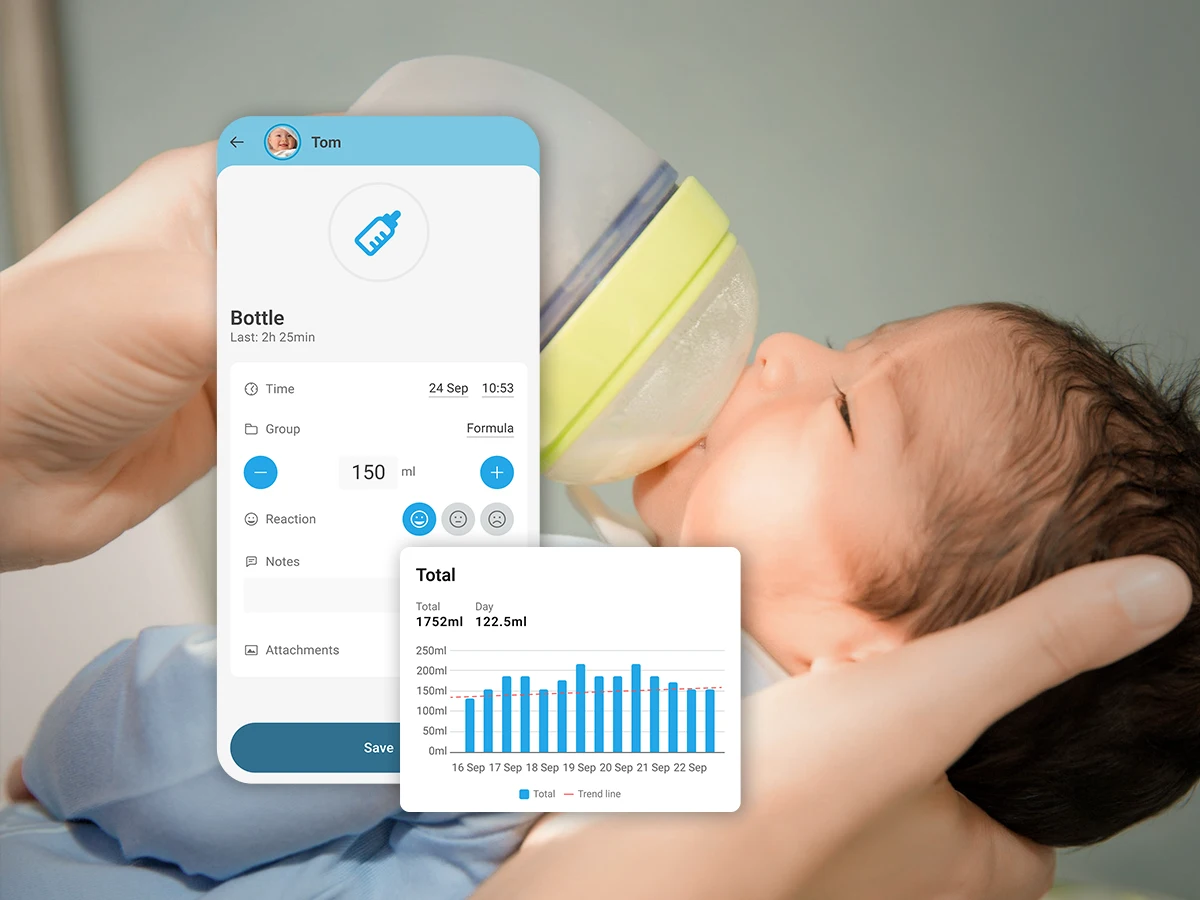
Baby Daybook lets you log bottle feeds and amounts as they happen. Then you can look back at the day or at longer-term patterns without keeping the numbers in your head. Widgets and the watch app give you quicker ways to check and track baby activities without always opening the app on your phone.
And feeding is rarely a one-person job. With Family Sync, a feed logged by one caregiver is available to the others, too. Your partner, grandparent, babysitter, or whoever has the next shift can see when the baby last ate without having to ask.
Tracking isn’t about making every day fit a perfect schedule. It’s there to make the routine easier to see, and easier to share.
FAQ
Can I prepare formula bottles ahead of time?
Yes, just refrigerate them immediately after preparation and use them within 24 hours. Don’t save a bottle that your baby has already drunk from.
Can I use tap water to make formula?
For most babies, tap water from a safe drinking-water supply can be used according to the formula manufacturer’s instructions. If you’re unsure whether your water is safe, check with your local health authority. Babies younger than 2 months, babies born prematurely, and babies with weakened immune systems need extra formula-preparation precautions, as explained above.
Can I add cereal to a bottle to help my baby sleep longer?
Don’t add cereal, sugar, or other ingredients to formula unless your baby’s healthcare professional specifically recommends it. Prepare formula using the amounts of water and formula specified on the label.
What should I do with formula my baby doesn’t finish?
Once feeding begins, use the bottle within 1 hour and throw away whatever is left. Your baby’s saliva introduces bacteria into the formula, so leftovers shouldn’t be refrigerated for another feed.
Sources
American Academy of Pediatrics. (2026). Food allergies and intolerances. American Academy of Pediatrics. www.aap.org
Centers for Disease Control and Prevention. (2025). How to clean, sanitize, and store infant feeding items. Centers for Disease Control and Prevention. www.cdc.gov
Centers for Disease Control and Prevention. (2026). How much and how often to feed infant formula. Centers for Disease Control and Prevention. www.cdc.gov
Centers for Disease Control and Prevention. (2026). Infant formula preparation and storage. Centers for Disease Control and Prevention. www.cdc.gov
Fuchs, G. J., III, & Abrams, S. A. (2023). Choosing a baby formula. HealthyChildren.org.
www.healthychildren.org
HealthyChildren.org. (2022). Amount and schedule of baby formula feedings. American Academy of Pediatrics. www.healthychildren.org
Jana, L. A., & Shu, J. (2025). Gas relief for babies. HealthyChildren.org. www.healthychildren.org
Velez, A., & Waasdorp Hurtado, C. (2025). Why babies spit up. HealthyChildren.org. www.healthychildren.org


