

Twice a year, the clocks change, and parents start looking for daylight saving baby sleep tips. Will it wreck bedtime? For many families, it means a few unsettled days. Some children take a week or two to adjust.
This guide covers four ways to handle the clock change, from preparing beforehand to adjusting afterwards, with tips for baby sleep after fall back and spring forward.
Quick answer
You have four options:
- Switch to the new clock without preparing: aim for your usual times and let sleep catch up.
- Split the difference: meet halfway for a few days, then move to the new time.
- Shift gradually: move sleep times 10–15 minutes a day, starting 4–6 days before the change.
- Keep the shift: if the new timing suits your family, simply keep it.
For newborns, follow sleep and feeding cues. At any age, your baby’s need for sleep and feeds comes before the plan.

Why Does Daylight Saving Time Affect Baby Sleep?
Your baby’s internal body clock, or circadian rhythm, helps determine when they feel sleepy or alert. It doesn’t change immediately when the clock on the wall moves by an hour.
Sleep also depends on sleep pressure, which builds while your baby is awake. Your baby may feel tired before their usual nap or still be wide awake at bedtime while their body adjusts.
Light helps set the body clock. Using it at different times of day can support the adjustment, as explained in the fall back and spring forward tips below.
Four Ways to Adjust Baby Sleep for Daylight Saving Time
These approaches are most useful for babies and toddlers whose sleep already follows a fairly predictable pattern. Research on daylight saving time in babies is limited, so choose what seems manageable for your family and adjust as needed.
If your baby is still in the newborn stage, their sleep rhythm is still developing, so there’s no need to shift a fixed schedule.
If daycare or nursery has fixed nap times, take those into account when choosing your approach. Keep milk feeds responsive to hunger and follow any individual advice from your baby’s healthcare professional.
1. Adjust Baby Sleep to the New Clock Without Preparing
On the day the clocks change, aim for your usual times for naps, family meals and bedtime on the new clock. If bedtime was 7:00 p.m., it’s still roughly 7:00 p.m.
Treat those times as a guide. If your baby is clearly tired before a planned nap or bedtime, offer sleep sooner.
Good for you if: you don’t want to prepare, the change has already happened, or your baby usually handles schedule changes well.
2. Adjust Baby Sleep After the Clock Change in Two Steps
Try moving halfway toward your usual schedule first. For a usual 7:00 p.m. bedtime:
- After fall back: aim for 6:30 p.m. on the new clock, then move to 7:00 p.m. after 2–3 days.
- After spring forward: aim for 7:30 p.m. on the new clock, then move to 7:00 p.m. after 2–3 days.
Move naps and family meals in the same direction where practical. Stay at the halfway point longer if your baby needs more time.
Good for you if: you want to soften the change without preparing beforehand.
3. Shift Baby Sleep Gradually Before Daylight Saving Time
The American Academy of Pediatrics (AAP) suggests shifting younger children’s naps and bedtime by a few minutes each day, starting about a week before.
A simple plan is 15 minutes a day for 4 days, or 10 minutes a day for 6 days:
- Before fall back, shift later.
- Before spring forward, shift earlier.
Move morning wake-up, naps, bedtime and family meals in the same direction where possible. If a step leaves your baby struggling, pause there before making another change.
Good for you if: your baby handles gradual changes better, or you like to plan ahead.
4. Keep the Shift if It Works for You
Sometimes the new timing suits your family. After spring forward, a 5:45 a.m. wake-up becomes 6:45 a.m. by the clock. After fall back, an earlier day might fit your family’s routine better.
You can keep that timing if your baby is getting enough sleep and managing well. It may still change as their body adjusts.
Good for you if: the new schedule works better than the old one.
Daylight Saving Baby Sleep Problems: Early Waking and Bedtime Battles
Early Waking After Fall Back: Helping Your Baby Sleep
When the clocks go back, a usual 7:00 a.m. wake-up becomes 6:00 a.m. Your baby may also get sleepy earlier before naps and bedtime. The AAP notes that younger children can experience both changes after the autumn clock change.
To help your baby move toward a later schedule:
- Keep early mornings quiet and dark. Comfort and feed your baby when needed, but save bright lights and play for the start of the day. Move that morning routine toward your intended wake-up time in small steps.
- Adjust nap time gently. For babies taking several naps, try moving the first nap 10–15 minutes later toward its usual time, if they can manage it. For toddlers on one nap, an early start may make the wait until midday too long. Offer the nap 15–30 minutes earlier for a few days if needed, then gradually return to the usual time.
- Get outside in the late afternoon. Daylight at this time may help move the body clock later. Keep your usual calm wind-down afterwards.
- Let the day guide bedtime. An earlier bedtime can help after poor naps or a very early start. Keeping your baby awake late won’t reliably produce a later morning.
Baby Sleep After Spring Forward: Bedtime Difficulties
When the clocks go forward, a 7:00 p.m. bedtime feels like 6:00 p.m. to your baby. They may not be ready to sleep, and lighter evenings can make settling harder. They may also want to sleep later in the morning.
To help:
- Get daylight in the morning. Open the curtains and get outside early when you can. Morning light helps move the body clock earlier.
- Reduce evening light. Close blackout blinds and dim the lights during the bedtime routine. Keep blind cords well out of reach of the cot or crib.
- Keep mornings reasonably consistent. Aim close to your baby’s usual wake-up time, with some flexibility after a poor night.
- Try a slightly later bedtime temporarily. If your baby isn’t sleepy, start 15–30 minutes later for a few days, then gradually move back. Offer sleep sooner if they’re already tired.
For either change, keep your familiar bedtime routine. The usual sequence of pyjamas, a feed, a book or a song gives your baby reassuring cues even when the timing changes.
Tracking Baby Sleep During the Daylight Saving Change
Tracking your baby’s sleep during the clock change can help you spot patterns that are hard to remember when you’re tired. A few days of logs may show whether wake-ups, naps and bedtime are gradually settling.
Plan and Follow Your Adjustments
Before the change, look at your baby’s recent sleep times. Their usual bedtime might be closer to 7:25 p.m. than 7:00 p.m. If you’re shifting gradually, use those actual times as your starting point.
Set a reminder in Baby Daybook and update it as your planned bedtime changes. Shared logs also help a partner, grandparent or nanny see when your baby last slept and follow the same plan.
Afterwards, compare a few days of logs. Are wake-ups moving toward your usual time? Is bedtime becoming easier? Those patterns can tell you more than a single difficult night.
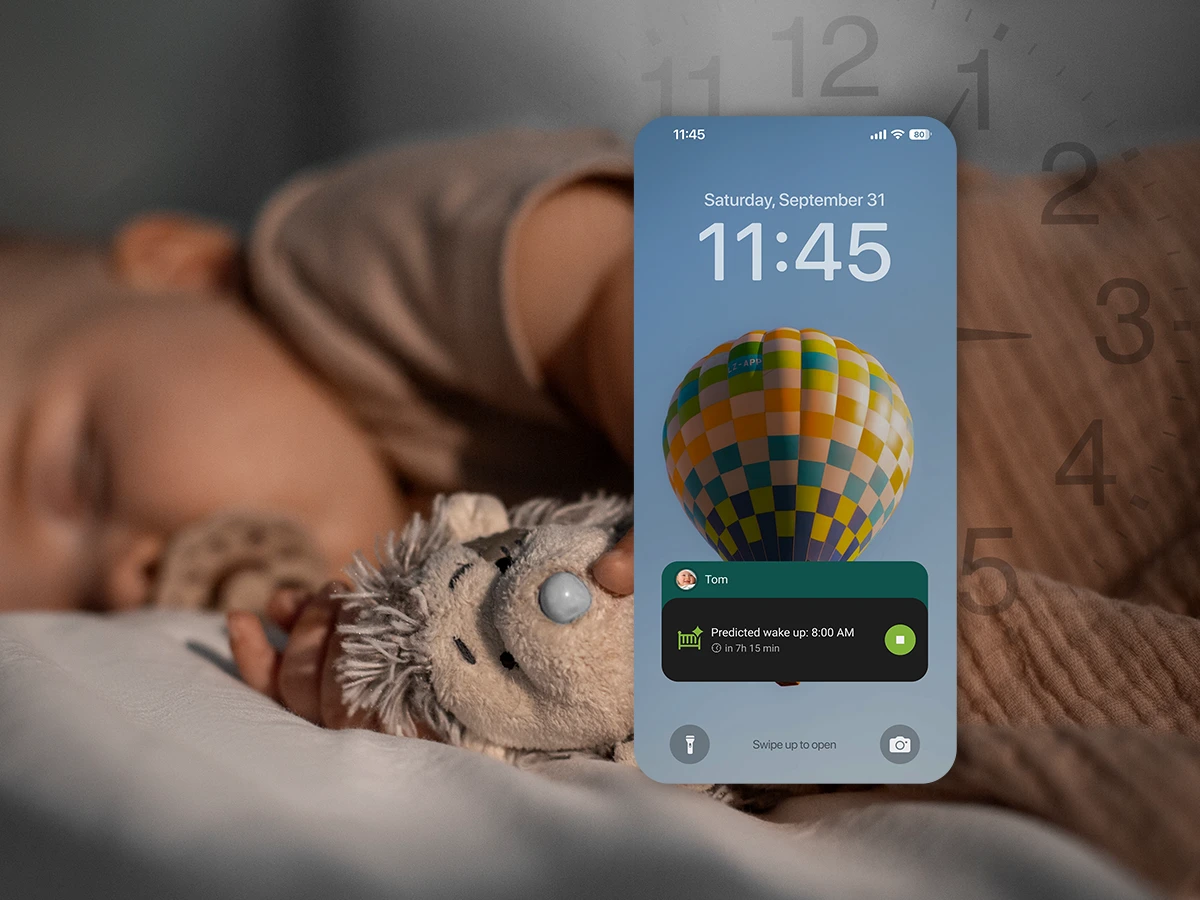
Use Sleep Predictions as a Guide
Baby Daybook’s Sleep Predictions use logged sleep and awake times, alongside your baby’s age and your settings, to suggest upcoming naps and bedtime.
The predictions update as you log. Use them alongside your baby’s cues and any adjustment you’re trying, with room to change a suggested time when needed.
Understand Sleep Totals on Changeover Night
Clock times can be misleading on the night of the change. Continuous sleep from 7:00 p.m. to 7:00 a.m. spans:
- 13 hours when the clocks go back.
- 11 hours when the clocks go forward.
That extra or missing hour can explain an unusual overnight total. If your baby wakes during the night, record awake periods as usual.
Final Thoughts
The clock change may make sleep less predictable for a while. You can prepare with small adjustments or take it as it comes – both leave room to respond to what your baby needs.
Some days may go more smoothly than others. Keep the familiar parts of your routine, allow flexibility around sleep times, and give yourselves time to settle into the new rhythm.
If sleep difficulties continue beyond a couple of weeks, get worse, or come with feeding problems or signs that your baby is unwell, speak with your baby’s healthcare professional. You can ask for advice sooner if you’re worried.
FAQs About Daylight Saving Time and Baby Sleep
How long does it take a baby to adjust after daylight saving time?
Sleep may be unsettled for a few days. Some children take a week or two to adjust. Look at the overall pattern: are wake-ups, naps and bedtime gradually settling?
Should I wake my baby at the “new” time after fall back?
You don’t need to wake your baby just because the clocks changed. Baby sleep after fall back often shifts earlier, so your baby may already be waking before their usual time. If your baby has a predictable routine, work gradually toward your preferred morning start while allowing flexibility after a poor night. For newborns, follow sleep and feeding cues and any feeding advice from their healthcare professional.
Is it better to adjust before or after the clock change?
Either approach can help. The AAP suggests gradually shifting younger children’s naps and bedtime before the change, but there’s no strong evidence that one approach is best for every baby. If you didn’t prepare, you can still adjust your baby’s sleep after spring forward or fall back over the following days.
Does daylight saving time affect newborns?
Newborns don’t yet follow a predictable day-night schedule, so a clock change may be less noticeable. Keep following sleep and feeding cues rather than trying to adjust a fixed schedule. Let normal daylight mark the day and keep nighttime care dim and quiet.
Does the clock change affect feeding schedules?
It can. Feeds may seem an hour earlier or later on the clock for a few days. Keep milk feeds responsive to hunger. If your child has regular meals or snacks, move those gradually along with the sleep schedule.
Sources
American Academy of Pediatrics. (2024). Getting your baby to sleep. HealthyChildren.org. www.healthychildren.org
Dumaplin, C. (2026). Daylight savings 2026: Fall back and baby or toddler sleep. Taking Cara Babies. www.takingcarababies.com
Dumaplin, C. (2026). Spring forward – Adjusting baby sleep for daylight savings 2026. Taking Cara Babies. www.takingcarababies.com
Esparham, A. (2025). Daylight saving time: Don’t lose sleep over it. HealthyChildren.org. www.healthychildren.org
Kok, E. Y., Kaur, S., Mohd Shukri, N. H., Abdul Razak, N., Takahashi, M., Teoh, S. C., Tay, J. E. F., & Shibata, S. (2025). The role of light exposure in infant circadian rhythm establishment: A scoping review perspective. European Journal of Pediatrics, 184, Article 112. doi.org
NHS. (n.d.). Feeding on demand. www.nhs.uk
Rishi, M. A., Cheng, J. Y., Strang, A. R., Sexton-Radek, K., Ganguly, G., Licis, A., Flynn-Evans, E. E., Berneking, M. W., Bhui, R., Creamer, J., Kundel, V., Namen, A. M., Spector, A. R., Olaoye, O., Hashmi, S. D., Abbasi-Feinberg, F., Abreu, A. R., Gurubhagavatula, I., Kapur, V. K., . . . Sullivan, S. S. (2024). Permanent standard time is the optimal choice for health and safety: An American Academy of Sleep Medicine position statement. Journal of Clinical Sleep Medicine, 20(1), 121–125. pmc.ncbi.nlm.nih.gov