

A Complete Guide to Feeding, Sleep, Diaper, and Growth Tracking for Newborn Twins
When you’re caring for newborn twins, it’s easy to lose track of what happened, and which baby it happened to. When did Baby A last eat? How long has Baby B been asleep? Which baby had the wet diaper? Who received their medication? And when more than one person is helping with care, someone else may need those same answers a few hours later.
Baby Daybook is designed to help with exactly that. Every baby gets their own profile. Every feed, nap, diaper, growth check, and medication dose stays attached to the right child, so nothing blurs into one big impression of “how the twins are doing.”
At the same time, keeping at least some parts of their routines lined up can make everyday life a lot easier. The goal isn’t to make your babies follow an identical schedule. It’s to keep each baby’s information clear, coordinate their routines where it actually helps, and make everyday care simpler to manage.
Should Newborn Twins Follow the Same Feeding Schedule?
There’s no single twin schedule that works for every family. When caring for newborn twins, keeping feeds roughly aligned can make everyday life more manageable.
A breastfed newborn typically nurses 10 to 12 times in 24 hours, according to AAP guidance. Formula-fed newborns tend to feed a little less often, closer to every 3 to 4 hours. Either way, double that for two babies, and that’s a lot of individual feeds in one day.
That’s why coordinating feeds is a common strategy for multiples. AAP guidance for parents of twins talks about waking both babies to eat when one wakes for a feed. NHS guidance says something similar, suggesting parents try to coordinate night feeds in the early days.
For healthy babies who are feeding and growing well, offering the other twin a feed around the same time can be a practical strategy. But an identical feeding schedule isn’t the goal, and it isn’t a rule. Each baby’s hunger and fullness cues, growth, feeding ability, and individual medical needs come first. If your babies were born early, are having feeding or growth trouble, or were given a specific feeding plan, follow your pediatric or neonatal team’s guidance instead.
Whether you breastfeed, bottle-feed, use expressed breast milk or formula, or mix methods, that’s okay. Logging each baby’s feeds separately in Baby Daybook lets you see each one’s pattern clearly, without expecting those patterns to match.
Bottle-feeding safety: If you feed two babies at the same time, each baby still needs safe positioning and active supervision. Bottles should never be propped or left in a baby’s mouth unattended. If you can’t safely supervise both babies at once, feed them one at a time instead.
How Should Newborn Twins Sleep Safely?
Safe sleep is one area where practical scheduling tips and medical safety guidance are two different things.
For families anywhere, the safest approach is to give each baby their own safe infant sleep surface, and follow the current safe-sleep guidance where you live.
In the United States, the AAP recommends placing babies on their backs on a firm, flat sleep surface with no loose bedding, pillows, toys, or other soft objects. It also recommends separate sleep surfaces for twins and higher-order multiples. NHS guidance in England is different. It allows small twins to share a cot, but only under specific safe-sleep conditions. NHS guidance also recommends keeping babies in the same room as their parents for the first 6 months.
Official recommendations vary by country, so follow the current safe-sleep guidance where you live. Ask your babies’ healthcare team if you’re unsure, especially if they were premature, had a low birth weight, or have other medical needs.
What If One Twin Is Growing Faster?
Twins don’t necessarily grow at exactly the same rate or stay on the same growth percentile. It’s tempting to compare them directly: Baby A weighs more. Baby B gained less this month. But each baby has their own growth trajectory. Instead of asking why one twin isn’t doing what the other is, it’s usually more useful to ask whether that baby is doing something different than usual for them. Healthcare professionals look at each baby’s growth pattern over time. They weigh things like gestational age, birth weight, feeding, medical history, and genetics. Trey’re not measuring one twin against the other.
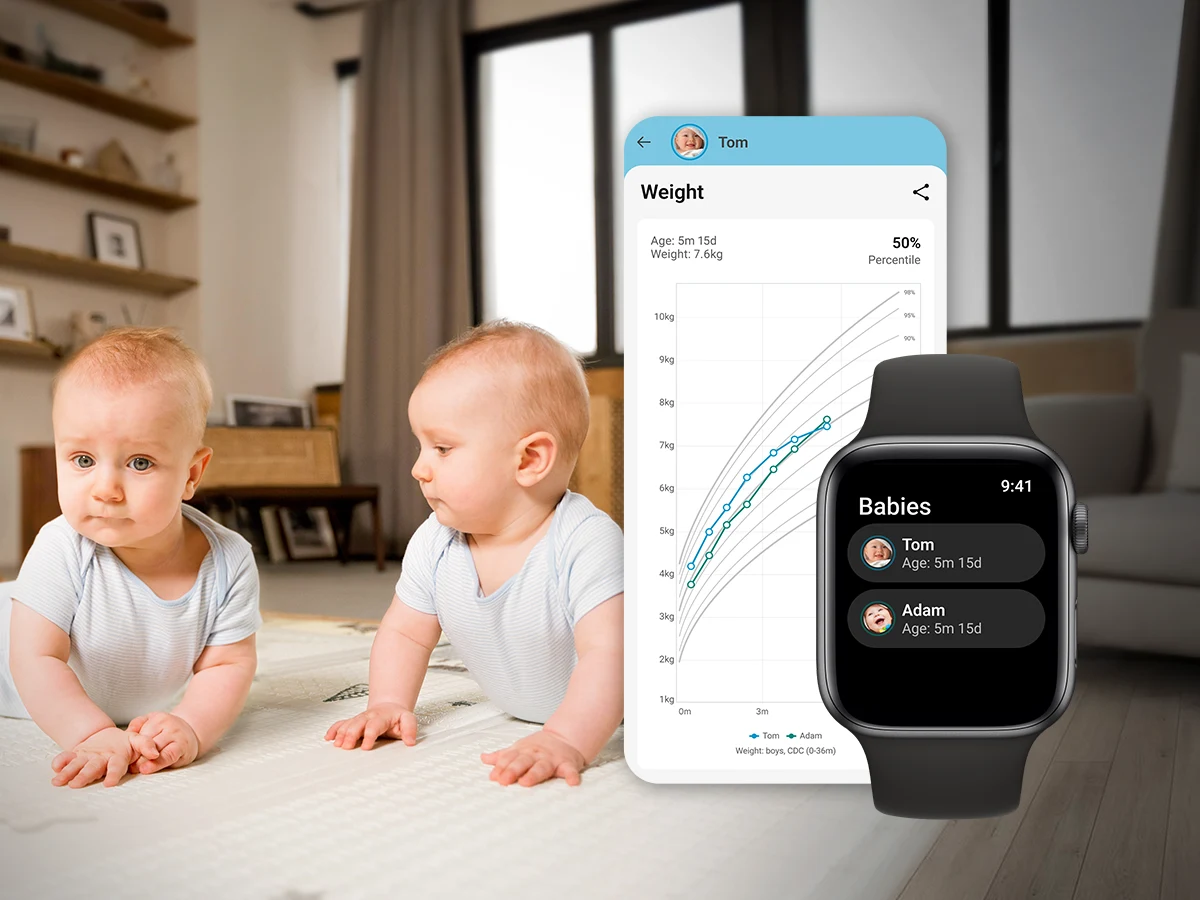
This is a place where seeing both babies’ numbers side by side is genuinely useful, as long as you read it the right way. A slower month for one twin makes more sense next to the other’s line than as a number you’re trying to remember on your own. Baby Daybook records each child’s height, weight, and head circumference tracked against CDC and WHO standards. If your twins are the same sex, you can view both on one growth chart, since boys’ and girls’ growth curves are measured separately. That gives you a real side-by-side view, without losing sight of each baby’s own path. For boy-girl twins, each baby gets their own chart, so the percentiles stay accurate to how they’re actually measured.
For babies born early, healthcare professionals usually take corrected age into account when looking at development. If one baby’s growth slows unexpectedly, feeding becomes hard, or you are worried about their development, talk with your pediatric healthcare professional. Your records in Baby Daybook can make that conversation easier, but they don’t replace it.
Diapers, Medications, and Everything Else Worth Watching
Diapers and medications are often the easiest things to lose track of with two babies. Was that wet diaper Baby A’s or Baby B’s, an hour ago? Was this Baby B’s first dirty diaper today, or the second one? Medication is different. If two babies need a dose, knowing exactly which baby got what, and when, matters more than almost anything else you’re tracking. Never assume medication instructions are interchangeable between twins. The same goes for anything your babies’ healthcare team has asked you to watch, like a symptom, a feeding amount, or a follow-up measurement.
The simplest approach is a separate routine and a separate record for each baby. Log things as they happen, instead of trying to remember them later. It’s a quick check that replaces the mental tally you’d otherwise be keeping for two babies at once. It’s also handy if your healthcare professional ever asks about a pattern you’ve noticed. That’s the job a baby-by-baby log in Baby Daybook does. Every feed, nap, diaper, and dose gets attached to the right child automatically, instead of sorted out later from memory.
Because each baby has their own profile, you can switch between them anytime to compare patterns, not just for growth. And if you’d rather not open the app to check, home screen widgets can show each baby’s most recent activity side by side.
Sharing the Care With a Partner or Other Caregivers
Tracking becomes even more valuable the moment more than one person is caring for the babies. Imagine your partner takes over while you sleep. Without a shared record, the handoff turns into a string of questions: Who ate? When? Did Baby B wake up? Which baby had the dirty diaper? Did anyone give the medication?
Sharing the care isn’t only about apps. Let someone bring dinner. Let someone else wash bottles or handle the laundry. Give visitors a job instead of just company. And if you have a partner or another trusted caregiver, trade off duties on purpose, so each of you actually gets a turn to rest. Other parents of multiples can help too. Some parts of life with twins are easier to explain to someone who’s already lived it.
The handoff itself gets easier with a shared, up-to-date record. Baby Daybook’s Family Sync lets you add your partner, a grandparent, or a nanny to your babies’ caregiver list. Everyone sees the same information: who ate, who’s due, who got a dose. No verbal handoff, no guessing game.
That matters for more than logistics. The postpartum period is demanding for any new parent. Research suggests that mothers of twins face a meaningfully higher risk of postpartum depression than mothers of a single baby. Partners show a smaller, more time-specific increase of their own. Being able to actually hand off care, rest when it’s your turn, and not carry the full picture alone, is protective. It’s not a luxury. If you’re feeling persistently overwhelmed, sad, or anxious, talk with a healthcare professional. You don’t need to wait until it feels severe to ask for support.
The Big Picture
With multiples, two pieces of advice can sound like they’re pulling in different directions: keep a routine that works, and treat two babies as two individuals. You don’t have to choose. Coordinate what genuinely makes the day easier, keep each baby’s own record separate underneath that, and let the rest stay flexible.
Your twins don’t have to run like synchronized clocks. The useful part is knowing what happened with each baby, and being able to find that information the moment you actually need it.
Frequently Asked Questions
Should I keep my twins on exactly the same schedule?
No. Coordinating feeds, sleep, and other parts of the day can make caring for twins easier, but their schedules don’t need to be identical. Each baby’s hunger cues, growth, feeding ability, medical needs, and individual care plan should come first.
If one twin wakes to eat, should I wake the other?
You can. Coordinating feeds is a practical strategy discussed in AAP and NHS guidance for twins, but it isn’t a rule for every baby. Follow individual feeding instructions from your pediatrician or neonatal team, particularly for premature babies or babies with feeding or growth concerns.
Is it safe for twins to share a crib or cot?
Guidance differs by country. The AAP recommends a separate sleep surface for each twin or higher-order multiple, while current NHS guidance in England allows small twins to share a cot under specific safe-sleep conditions. Follow the current safe-sleep guidance where you live.
Is it normal for twins to have different growth percentiles?
Twins can have different growth patterns. What matters more is how each baby grows over time. If one baby’s growth slows, changes unexpectedly, or concerns you, discuss it with their healthcare professional.
Can I breastfeed twins?
Yes. Some parents tandem breastfeed, others feed one baby after another, and some use expressed breast milk, formula, or a combination. Prematurity, feeding difficulties, milk supply, and individual circumstances can all affect what works best.
How do I bottle-feed twins by myself?
Each baby needs safe, active supervision while feeding, so never prop a bottle. Many parents use a nursing pillow or feeding cushion on each side to help support both babies in a semi-upright position while feeding them one bottle each at the same time. If you can’t safely watch both babies while feeding them together, it’s fine to feed them one after the other instead.
How do I avoid mixing up which twin ate or had a diaper change?
Keep a separate record for each baby and log activities as they happen when you can. Baby Daybook uses separate baby profiles so every logged activity stays attached to the right child instead of blending into one combined record. If several people care for the babies, using the same tracking system can make handoffs easier.

Sources
American College of Obstetricians and Gynecologists. (2023). Screening and diagnosis of mental health conditions during pregnancy and postpartum: ACOG Clinical Practice Guideline No. 4. Obstetrics & Gynecology, 141(6), 1232–1261. www.acog.org
Centers for Disease Control and Prevention. (2026). About feeding from a bottle. www.cdc.gov
Centers for Disease Control and Prevention. (2026). Signs your child is hungry or full. www.cdc.gov
Egsgaard, S., Bliddal, M., Lund, L. C., Vigod, S. N., & Munk-Olsen, T. (2025). Risk and timing of postpartum depression in parents of twins compared to parents of singletons. Acta Psychiatrica Scandinavica, 151(2), 163–172. doi.org
Flais, S. V. (2026). Feeding twins on a schedule: Tips for new parents. HealthyChildren.org, American Academy of Pediatrics. www.healthychildren.org
Moon, R. Y., Carlin, R. F., Hand, I., Task Force on Sudden Infant Death Syndrome, & Committee on Fetus and Newborn. (2022). Sleep-related infant deaths: Updated 2022 recommendations for reducing infant deaths in the sleep environment. Pediatrics, 150(1), e2022057990. doi.org
National Health Service. (2026). Twins and sleep. www.nhs.uk
National Health Service. (2026). Feeding twins and multiples. www.nhs.uk